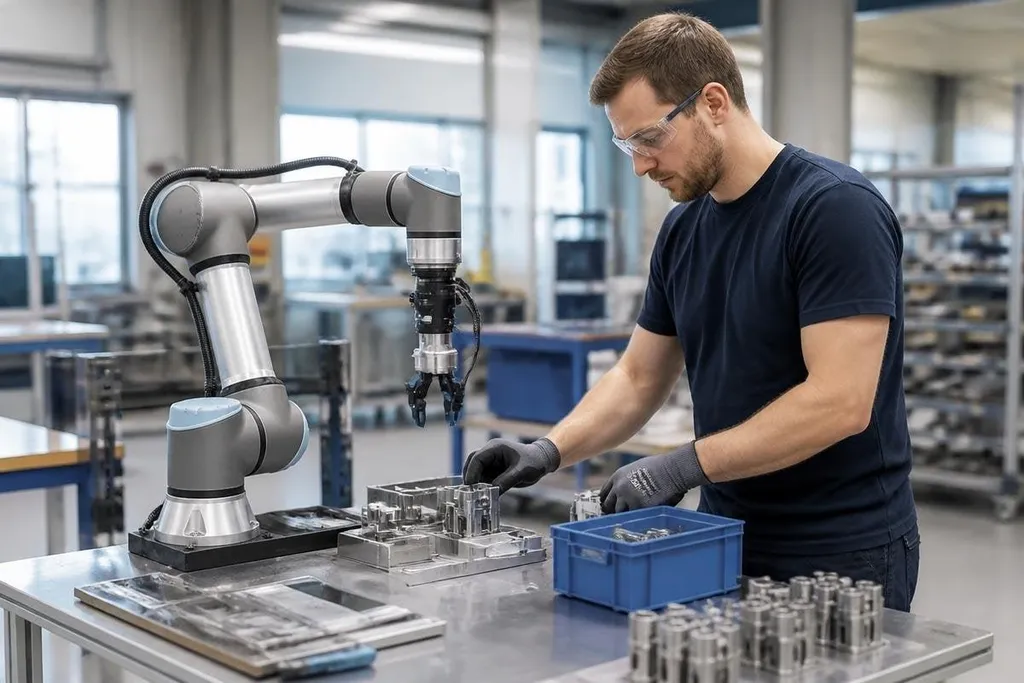
A collaborative robot, or cobot, can work near people when its safety functions and task setup allow it. That changes where automation can fit: beside an operator, on a small line, or at a station that cannot house a fenced industrial robot.
Quick read
- Cobots fit tasks that change often
- Force sensing can stop motion after contact
- A safety review still comes before production
The gap cobots fill
Traditional industrial robots suit fixed jobs with high speed and repeatable motion. They often need guarding, floor space, and a carefully set production layout. That works for a large line, but it can be hard to justify for a small batch or a station used by several teams.
Cobots give manufacturers another option. An operator can load parts, check a result, or change a fixture while the robot handles a repeated movement nearby. The value comes from sharing one work area, not from removing people from the task.
This matters to a plant manager with limited floor space. A cobot can sit on a mobile stand, move between stations, and run a new task after a software change and a new tool setup. Those steps still need trained staff, but the equipment can serve more than one process.
How the safety functions work
The word collaborative describes a safety approach, not a promise that every task is safe beside a person. A cobot may use joint torque sensing, force limits, speed limits, monitored stops, or a tool that reduces the chance of injury. The exact functions depend on the model and its setup.
Force sensing lets the robot detect resistance in its joints or at the tool. If the measured force passes a set limit, the robot can stop or reduce motion. That helps with contact risks, but it does not make a sharp tool, heavy part, or fast-moving fixture safe by itself.
A risk review checks the full work cell. It includes the robot, gripper, part, table, software, operator position, and restart process. A low-force arm can still cause harm if it carries a heavy load or moves an object with a hard edge.
Why smaller teams are paying attention
Cobots can suit companies that lack a large automation team. Many tasks can be taught through hand guiding: the operator moves the arm through a path, records points, and sets the order of actions. More complex jobs still need programming, sensor setup, and checks for reach, timing, and collisions.
That shorter setup path can help when product demand changes. A factory making several part types may use one cobot for loading, screwdriving, inspection, or packing, then change the end effector, which is the tool at the robot’s wrist, for another job.
The limits are clear. A cobot usually gives up some speed when people work close to it. Its payload, reach, and cycle time may also be lower than those of a fenced industrial arm. If a line runs one heavy part at high speed all day, a conventional robot may fit better.
The purchase decision follows the robot onto the factory floor. Robot24.com robotics coverage links company plans, machine changes, and factory use cases to the work a cobot must handle after installation.
Where the business case can fail
The arm is only one part of the cost. You may need a gripper, stand, vision camera, safety scanner, fixtures, software work, training, and maintenance.
A low purchase price can lose its appeal if the task needs many custom parts or frequent manual resets. Cycle time needs the same care. A system that handles one part every 20 seconds may fit a slow station but miss the output target on a faster line. Ask for the measured cycle time with the real part, tool, handoff, and safety settings in place.
Integration can also decide the result. The cobot must exchange signals with the machine beside it, stop safely when a person enters the work area, and restart in a known state. A demonstration with an empty gripper says little about those steps.
A buying checklist
Use these checks before choosing a cobot for production:
- Name the task: Record the part weight, cycle time, reach, tool, and handoff.
- Test the real cell: Run the robot beside the table, machine, fixture, and operator position it will use.
- Check the stop behavior: Confirm what happens after contact, a sensor trigger, a power loss, and a restart.
- Price the whole setup: Add the gripper, stand, sensors, software work, training, and service parts.
- Set a pass mark: Decide the output, uptime, and defect rate the cell must meet before purchase.
I'd choose a cobot when the task changes often and people still need to work at the same station. For a fixed, high-speed job, a guarded industrial robot is usually the cleaner choice.
The next useful test is a timed run with the real part and the final safety settings. If that run meets the required output without constant operator resets, the cobot has a job worth buying for.